Santa Fe retailers turning to controversial license plate-reading technology
By Nicholas Gilmore
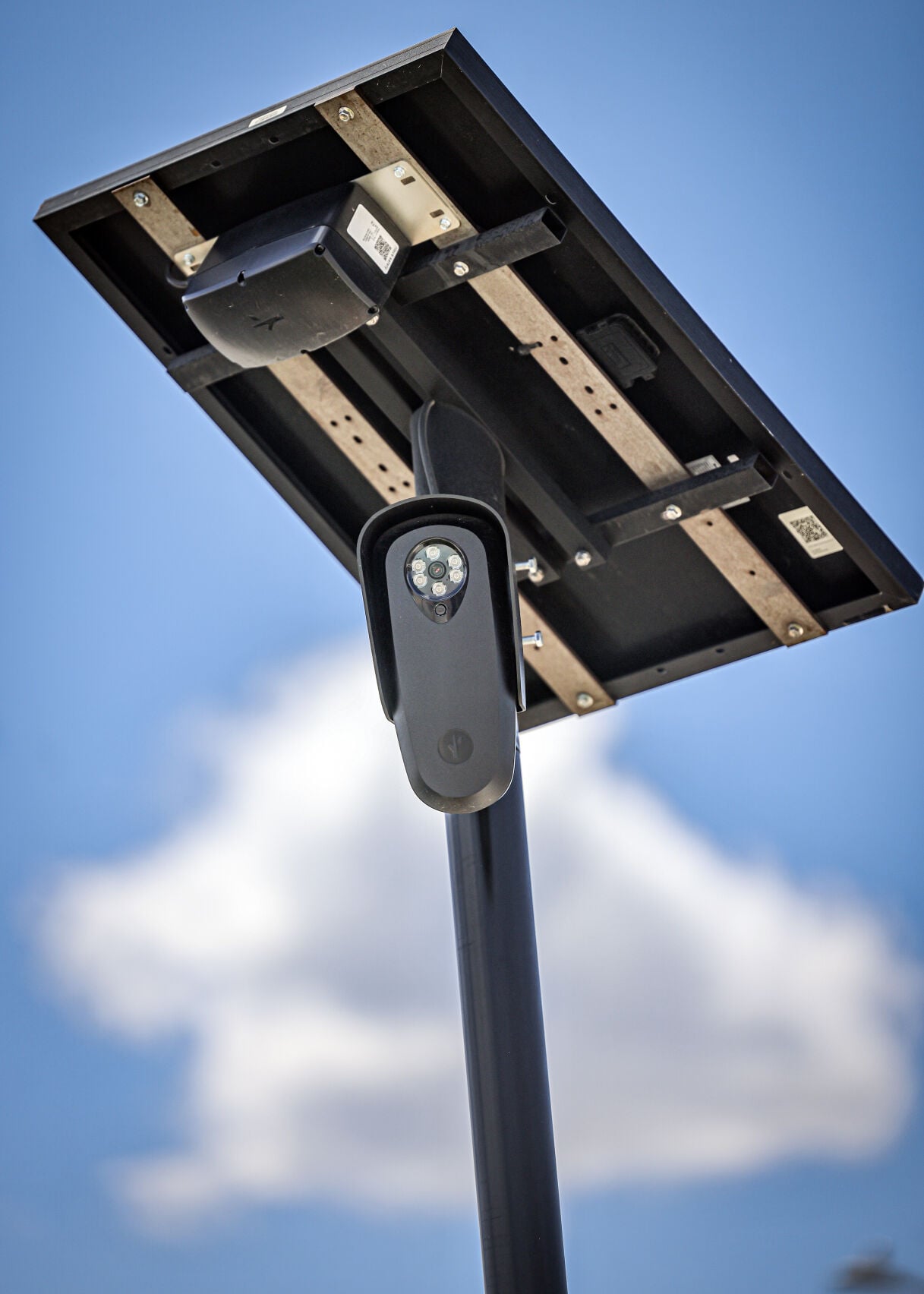
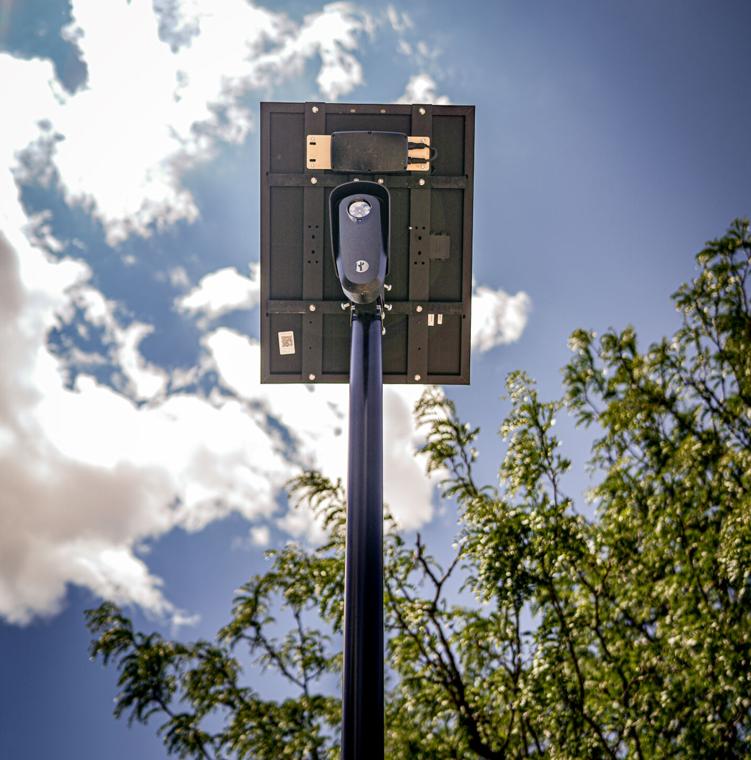
While coming and going in some shopping market parking lots in Santa Fe, you might have noticed a black, solar-powered camera trained on lanes of traffic.
Even if you didn’t, it noticed you.
The cameras — automated license plate readers — are capable of detecting and storing images of every license plate that passes by, creating a potentially powerful record of the whereabouts of thousands of local people.
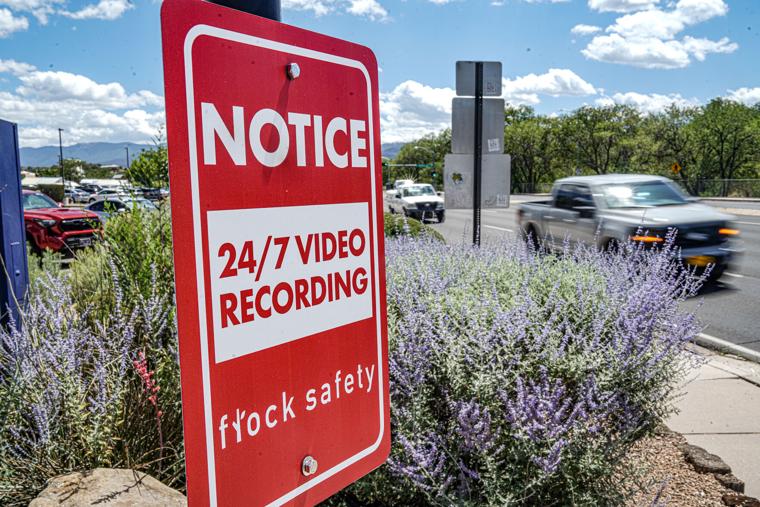
Although it isn’t clear exactly when they appeared, four such cameras are watching the parking lot surrounding the downtown DeVargas Center, and four more border the parking lot of the south-side Lowe’s Home Improvement store. One of the cameras at DeVargas Center appears to face outward, potentially capturing traffic traveling southbound on Guadalupe Street.
While use of the surveillance technology has become ubiquitous among law enforcement agencies around the nation, license plate readers in recent years have been popping up increasingly on private property, driving concerns about privacy and questions about the use of such data by private companies.
Many associate automatic license plate-reading cameras with the company Flock Safety, an Atlanta-based firm that bills itself as the largest provider of fixed license plate readers in the world. The cameras installed at DeVargas Center and Lowe’s feature the Flock logo, a twig with a single leaf.
Neither Lowe’s nor the company that manages DeVargas Center, Fidelis Realty, returned messages seeking comment on the cameras and any data agreements in connection with them.
A website created to map license plate-reading cameras — called DeFlock — shows seven other fixed cameras in and around Santa Fe — some of them on public streets and others on private property. One camera is across the street from the downtown Santa Fe post office, and several can be seen at each entrance to the campus of Santa Fe Community College south of the city.
The New Mexican could not confirm locations for others marked on the open-source mapping tool.
All profit, no transparency?
In a recent query on social media, more than two dozen Santa Fe residents weighed in on the cameras, with most expressing skepticism about the technology’s usefulness — and raising questions about surveillance by private companies.
One man said he worried how license plate readers fit into a larger “ecosystem” of surveillance, noting he will “absolutely” plan to avoid driving in places where the cameras can capture his license plate.
A few people said, however, they didn’t mind the cameras, expressing hope the devices would help deter crime.
Advocacy groups like the American Civil Liberties Union and the Electronic Frontier Foundation have for years raised concerns about surveillance technology like license plate-reading cameras, citing the risks of unaccountable monitoring that can be combined with tools like facial recognition technology to create powerful systems that are ripe for abuse.
Dave Maass — a director of investigations for Electronic Frontier Foundation who investigates surveillance technology for the organization — said license plate reader manufacturers have been courting private-sector customers, such as homeowners associations, for at least a decade, but the rise of Flock has made the issue more visible.
“Keep in mind, all of these companies that sell license plate readers — they are primarily responsible to their investors, and so they are going to try to find whatever market they can to sell this to, and there are a finite number of law enforcement agencies in the country,” Maass said. “Certainly, this is all about profit and not really about public safety, in my opinion.”
While Maass has used public records requests to find out about the uses of license plate-reading cameras by government agencies, when it comes to private companies, he said, “all transparency measures are out the window.”
“We don’t know how long the [data] retention periods are,” he said. “We don’t know who they’re sharing it with. We don’t even know what they’re doing with it — you want to assume that, in good faith, that they’re using this for shoplifting cases, but they could be feeding it into systems that are analyzing it for commercial purposes, for all we know.”
At least three states prohibit the use of automated license plate readers by private entities.
Is customer privacy at risk?
Santa Fe-based free speech advocate and legal scholar Heidi Li Feldman pointed out law enforcement agencies aren’t the only entities that might be interested in the reams of data produced by license plate readers.
Feldman, a professor emeritus of law at Georgetown University Law Center, said nothing is preventing stores from sharing — or selling — their data with anyone they choose.
“All sorts of private parties try to track people — even stalk them — and would welcome and pay for the data to analyze their targets’ driving patterns,” Feldman said. “Stores are putting their customers at risk of having their civil rights violated and their personal safety endangered.”
Representatives of Flock Safety did not respond to a request for comment seeking more information about the company’s data agreements with private companies that use its cameras, including those in Santa Fe. The company has said the data from its cameras are “only available to law enforcement agencies,” and that its systems default to permanently delete all data after 30 days.
Police use of license readers
The Santa Fe Police Department does not have open access to any private license plate-reading cameras in the city, interim police Chief Ben Valdez said.
Such access would require a memorandum of understanding between the agency and the company that controls the cameras, he said, adding such an agreement has been proposed in recent years but none has been signed.
“We would prefer not to just have open access to it,” Valdez said, noting police would prefer to get information from the cameras on a case-by-case basis. “But for investigative leads they would be very helpful in us getting crimes resolved.”
The city’s police force has license plate-reading cameras installed on each police cruiser as part of its contract with Axon Technologies, the company contracted to provide body cameras, dash cameras, stun guns and a case management system.
The data from the city’s license plate readers is “walled off,” Valdez said, although the agency has looked into signing a data-sharing agreement with New Mexico State Police.
Santa Fe police do not have any fixed cameras currently in place, but he noted it is something the agency is considering.
Many law enforcement agencies nationwide have invested in the systems and extolled the value of license plate readers in closing cases.
A Flock camera led to the recovery of several stolen vehicles earlier this month north of Santa Fe after Tesuque Pueblo police officers received an alert from one of the agency’s cameras that scans traffic just off U.S. 84/285 on Camel Rock Road.
The tribal police agency on June 16 received the hit, which alerted them to a license plate registered as stolen out of Albuquerque, according to a police affidavit. Officers were dispatched to a gas station nearby, where they recovered a white Mazda that had been reported stolen as well as a motorcycle and two electric bicycles that were in a pickup at the scene, police wrote.
New state law takes effect
Some uses of the technology by law enforcement, however, have reflected a seemingly dystopian surveillance power for police.
Last year, the technology came under intense scrutiny after a report in the outlet 404 Media revealed a Texas sheriff’s office conducted a search of more than 83,000 Flock cameras — including some in New Mexico — as part of an investigation into a woman who was suspected of having self-administered an abortion.
The revelation spurred legislation in several states, including New Mexico. The Driver Privacy and Safety Act, which was signed into law earlier this year, prohibits anyone in the state from sharing license plate reader data with another for the purposes of investigations related to immigration enforcement, “protected healthcare,” such as abortion, or free speech. The law, which went into effect Wednesday, requires anyone who uses the technology to obtain a written declaration from any out-of-state party before sharing data with them.
The legislation was sponsored by Senate Majority Leader Peter Wirth, D-Santa Fe, who said he first proposed the bill several sessions back. A consensus formed around the provisions that passed this year after news of the Texas investigation that included searches of cameras in New Mexico.
While the new regulations for license plate readers do appear to cover private entities as “users” of the technology, Wirth said in a recent interview the proliferation of the cameras in the private sector was not a significant consideration when he brought the bill forward.
“You can’t have people accessing this data for the wrong reasons,” Wirth said. “Obviously, all these same arguments apply to the use of private cameras, so to the extent that those get pulled underneath this bill, that’s a good thing, but our focus was really law enforcement.”
His primary concern around license plate readers, he said, is the data they generate — how long it is stored and who gets access. He noted there are more regulations he would like to bring forward for the devices, such as limits on the amount of time data can be stored. Such time limits range from 150 days in Arkansas to three minutes in New Hampshire. New Mexico currently has no limits on the books.
“It’s always better to try and regulate these things on the front end and then roll out the product,” he said. “I think in this case, what’s happened is this product was rolled out at high speed — it’s been very effective, and law enforcement will tell you about all the wins because of the cameras, and yet now we’re trying to put guardrails on after it’s already in place, and that’s harder to do.”
en
2026-07-04T05:30:00.0000000Z
2026-07-04T05:30:00.0000000Z